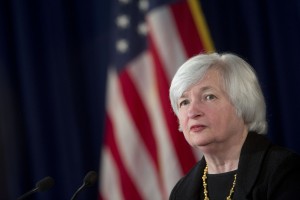

Janet Yellen,
Chair of the Board of Governors
Reserve System
Chair of the Board of Governors
Reserve System
While testifying before Congress on Wednesday, Federal Reserve Chair Janet Yellen noted that persistent economic headwinds have kept the federal funds target rate at a historically low level—and that future rate hikes may occur even more gradually than originally anticipated.
One Federal Open Market Committee meeting has already come and gone since December’s historic Fed liftoff without another rate hike. In her testimony before the House Financial Services Committee on Wednesday when discussing monetary policy, Yellen pointed out factors that have weighed on aggregate demand, such as limited access to credit for some borrowers, weak growth abroad, and the dollar’s significant appreciation. Inflation also remains way below the Fed’s 2 percent objective.
“The FOMC anticipates that economic conditions will evolve in a manner that will warrant only gradual increases in the federal funds rate,” Yellen said. “In addition, the Committee expects that the federal funds rate is likely to remain, for some time, below the levels that are expected to prevail in the longer run. This expectation is consistent with the view that the neutral nominal federal funds rate—defined as the value of the federal funds rate that would be neither expansionary nor contractionary if the economy was operating near potential—is currently low by historical standards and is likely to rise only gradually over time.”
“In addition, the Committee expects that the federal funds rate is likely to remain, for some time, below the levels that are expected to prevail in the longer run.”Janet Yellen, Fed Chair
The nation experienced paltry GDP growth (0.7 percent) in the first estimate for the fourth quarter and job gains of only 151,000 for January, slightly more than half of the monthly average for October through December. One notable aspect of the most recent employment summary is that in January, the unemployment rate dipped below 5 percent for the first time in eight years.
Yellen stated that “financial conditions in the United States have recently become less supportive of growth, with declines in broad measures of equity prices, higher borrowing rates for riskier borrowers, and a further appreciation of the dollar,” and forecasted a moderate pace of economic growth for the coming years against a backdrop of gradual monetary policy adjustment, ongoing employment gains, and faster wage growth that support real income growth and consumer spending.
“Of course, economic growth could also exceed our projections for a number of reasons, including the possibility that low oil prices will boost U.S. economic growth more than we expect,” Yellen said. “At present, the Committee is closely monitoring global economic and financial developments, as well as assessing their implications for the labor market and inflation and the balance of risks to the outlook.”
Some economists were less optimistic in their assessment of Yellen’s remarks. According to Capital Economics, “Fed Chair Janet Yellen’s testimony to Congress today revealed that, while the FOMC might not be ready to raise interest rates for a second time in March, she still anticipates a “gradual” series of rate hikes over the next couple of years. That view is clearly at odds with futures markets, which imply that any additional rate hikes are almost now off the table.”
Curt Long, Chief Economist with the National Association of Federal Credit Unions, stated, “In her testimony, Chair Yellen noted the emergent risks posed by weak financial markets and the declining prospects for growth abroad. While she did not indicate how this would play into the FOMC’s outlook for future rate increases, it seems far more likely than not that the committee will revise down its expectation of four rate hikes in 2016 in their March release.”
When Committee Chairman Jeb Hensarling (R-Texas) took the floor for his opening statement at Wednesday’s hearing, he was a little more blunt in his assessment of the recent economic headwinds.
“The reality is since the president was elected and the Fed embarked upon its unprecedented quantitative easing and zero real interest rate policies, working families’ paychecks have declined, their net wealth has declined and the real unemployment rate continues to hover around 10 percent,” Hensarling said. “Approximately one in six is on food stamps and almost 15 percent live in poverty. There hasn’t been a single year when economic growth has reached 3 percent.”
Hensarling continued, “Now I will not use this hearing to either praise or condemn the Fed’s decision to raise rates by 25 basis points interest rates in December. Nor do I think it appropriate to advise the FOMC on how to vote during its next meeting. But given that Article One, Section Eight of the Constitution gives Congress the power to coin money and regulate the value thereof, I do feel compelled to demand that the Fed adopt a monetary policy course that is predictable, transparent and sustainable and—barring terribly exigent circumstances—to stick with it. That is part of the rationale underlying the House-passed Fed Oversight Reform and Modernization Act—the FORM Act.”
Rep. Maxine Waters (D-California), ranking member of the Committee, was more positive than Hensarling regarding economic progress, but noted that there is more room for improvement.
"As a result of your herculean efforts, the efforts of Democrats in Congress, and the Obama Administration, we have truly made tremendous progress since the darkest days of the financial crisis," Waters said. "Over the past 71 consecutive months our economy has added more than 14 million private sector jobs, and the unemployment rate has fallen by more than half. But despite this commendable progress, significant work remains. Wages have yet to see real gains, 7.8 million workers remain jobless, 6 million workers are involuntarily working part-time jobs, and another 2 million Americans indicate they would join the workforce if only the economy were strong enough to support them. With inflation consistently running below target, I question whether the expected path for further raising rates over the course of 2016 may over emphasize concerns about inflation, and underestimate the weakness in our labor market."
