 Employment numbers and current mortgage payments among buyers are driving the health of the housing markets across the United States, according to Freddie Mac's Multi-Indicator Market Index (MiMi) for November 2015 released Tuesday.
Freddie Mac found that the U.S. housing market continued to stabilize as the MiMi value rose to 82.5 as of November 2015, meaning that the market is on its outer range of stable housing activity.
According to the report, the MiMi value is up 0.82 percent month-over-month and 7.23 percent year-over-year. Over the last three months, the MiMi has risen 2.09 percent.
The MiMi is up 39 percent from the all-time low recorded in October 2010, but remains far off from the peak of 121.7, the report stated.
"We saw another strong year-over-year improvement at 7.23 percent in this month's MiMi, the best 12-month showing in a year," said Len Kiefer, Freddie Mac Deputy Chief Economist. "The regional variation of housing activity continues to become more pronounced."
Pushing the MiMi upward are the employment and current mortgage payment indicators in the housing market, which are both in the stable range. Freddie Mac reported that the employment indicator led the index gains with 105.5 points in November 2015, up 0.23 percent from the previous month and 7.43 percent from one year ago. The current on mortgage indicator stood at 84.8 points, down 0.60 percent from last month but up 9.65 percent from last year.
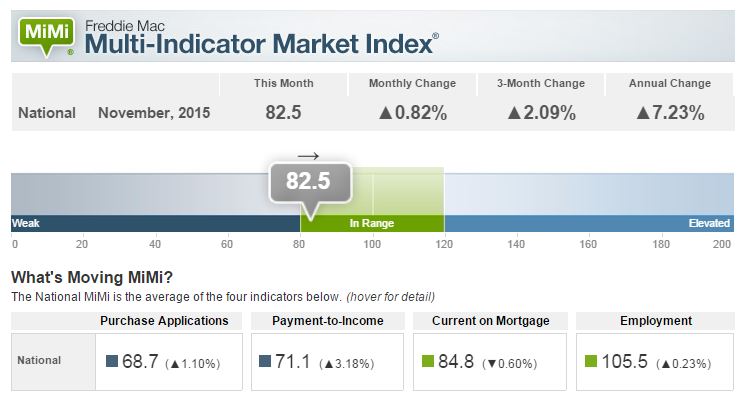 Meanwhile, the purchase applications and payment-to-income indicators came in weak for November 2015. The purchase applications indicator rose 1.10 percent from the prior month to 68.7 points and is up 8.71 percent year-over-year. The payment-to-income indicator rose 3.18 percent to 71.1 points and is up 2.85 percent from last year.
"We're still seeing declines in oil-dependent housing markets, whereas the hardest hit metros from the Great Recession continue to see some of the best improvement as they recover," Kiefer stated. "And at the same time, other markets are seeing even stronger improvement because of robust home sales fueled by strong local economies that remain largely affordable for the typical homebuyer. And in the short-term, we expect homebuyer affordability to remain strong with mortgage rates continuing to look very attractive to prospective homebuyers."
Freddie Mac's Top 5 States With MiMi Values in the Stable Range:
- District of Columbia (101)
- North Dakota (96.5)
- Hawaii (95.9)
- Montana (95.7)
- Utah (93.3)
Freddie Mac's Top 5 Metros With MiMi Values in the Stable Range:
- Fresno, California (102.9)
- Austin, Texas (97.5)
- Honolulu, Hawaii (97.1)
- Salt Lake City, Utah (96.7)
- Denver, Colorado (96.5)
