Is Fannie Mae and Freddie Mac Effective at Preventing Foreclosures? #housingmarket #housing #realestate #foreclosures #oregon
 It may be tougher to qualify for a mortgage loan to buy a home now than it was 10 years ago. But at least Fannie Mae and Freddie Mac are helping borrowers who already have homes to stay in them.
The GSEs have stated that preventing foreclosures and finding solutions for borrowers is a top priority for them. With October’s total of 17,521 foreclosure prevention actions completed, the GSEs have prevented approximately 3.61 million foreclosures since the conservatorships began in September 2008—and 2.97 million of those actions have been home retention actions, according to the Federal Housing Finance Agency (FHFA)’s October 2015 Foreclosure Prevention report released on Wednesday.
The number of home retention actions completed in October (14,377) was nearly the same as September’s total (14,746). Nearly 11,000 of these actions were permanent loan modifications, which brought the total since the conservatorships began up to approximately 1.88 million—accounting for more than half of the 3.61 million foreclosure prevention actions completed since September 2008. Other home retention actions included repayment plans, forbearance plans, and charge-offs in lieu.
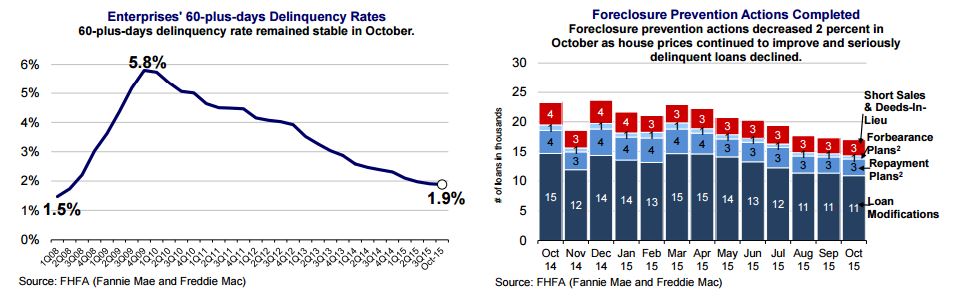
The number of home forfeiture actions completed by the GSEs, which include short sales and deeds-in-lieu of foreclosure, also remained little changed from September to October (2,707 compared to 2,744). There was little movement in the total number of foreclosure prevention actions completed by Fannie Mae and Freddie Mac from September to October (17,453 compared to 17,121).
The serious delinquency rate on single-family residential homes backed by either Fannie Mae or Freddie Mac ticked downward from 1.52 percent in September to 1.50 in October, according to FHFA. This percentage is close to its 2008 level, right around the start of the crisis, and is close to one-third of thenational average reported by CoreLogic for October (3.4 percent).
While the number of foreclosure starts on GSE-backed properties declined by 12 percent from September to October (from 21,590 down to 18,946), the number of third-party and foreclosure sales remained virtually unchanged over-the-month (9,143 in September to 9,105 in October).
