 The topic of bubbles forming in the housing market is something that has been thrown around for quite some time. As home prices soar to new heights—with no sign of decline—housing bubbles appear to be popping up in many markets.
Housing markets situated in ever-popular (and expensive) San Francisco, California are showing bubble signals, but experts believe that other markets are not too far behind.
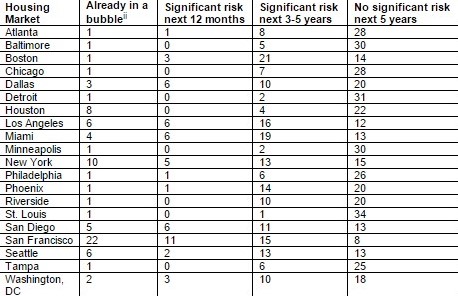
Zillow's Home Price Expectations Survey of 108 panelists showed that one-third of respondents agreed that the San Francisco housing market is in a bubble, while 20 percent indicated that the market is at-risk for bubble conditions in the next year.
"Without 20/20 hindsight, it's difficult to identify bubbles as they're happening, but it is very clear that nationally we are not seeing a return of the conditions that caused the last national bubble," said Dr. Svenja Gudell, Zillow's Chief Economist. "Tighter lending restrictions today mean we aren't seeing buyers get loans they realistically can't pay back, like we did in years past. It's significant that some experts are starting to worry about bubble conditions, but in my opinion, there's no real danger of a severe crash like the one we all remember from the last decade."
In addition to San Francisco, California, New York City, New York; Houston, Texas, and Los Angeles, California; Miami, Florida; San Diego, California; and Seattle, Washington were at the top of Zillow's list markets that are already in a housing bubble.
"A handful of markets–especially the Bay Area–are very hot right now, and it's possible home values may actually begin to fall somewhat in these places as more residents are priced out amidst rising affordability concerns, especially when interest rates rise. Whether those local conditions constitute a 'bubble' is up for debate, even among economists," Dr. Gudell explained.
 According to Zillow's panelists, home values are projected to grow at an annual rate of 3.9 percent through the end of 2015, which shows that the housing market will start to slow. All panelists agreed that the expected average annual home-value appreciation rate is now just over 3 percent, resulting in a national median home value of more than $215,000 by the end of 2020.
"The long-term outlook for U.S. home values has diminished to a three-year low, and a clear-cut consensus among the experts remains elusive, even at the national level," said Terry Loebs, Pulsenomics Founder. "Based on the projections of the most optimistic forecasters, home values nationally will increase 4.7 percent next year and surpass their May 2007 peak levels in April 2017.
Loebs continued, "In contrast, the data collected from the panel's most pessimistic respondents expect only 2.3 percent appreciation for next year, and even more subdued appreciation thereafter–a path that would delay the market's eclipse of the bubble peak until September 2019. The divergence of expert views regarding the existence of regional price bubbles and the path of future home values is a reminder that the U.S. housing sector has yet to fully heal more than eight years after the epic bust, and that significant risks have re-emerged within certain large metropolitan area housing markets."
 |
| Justin Lee Thayer 541 543 7287 |